
Controlling Runaway Cloud Spend
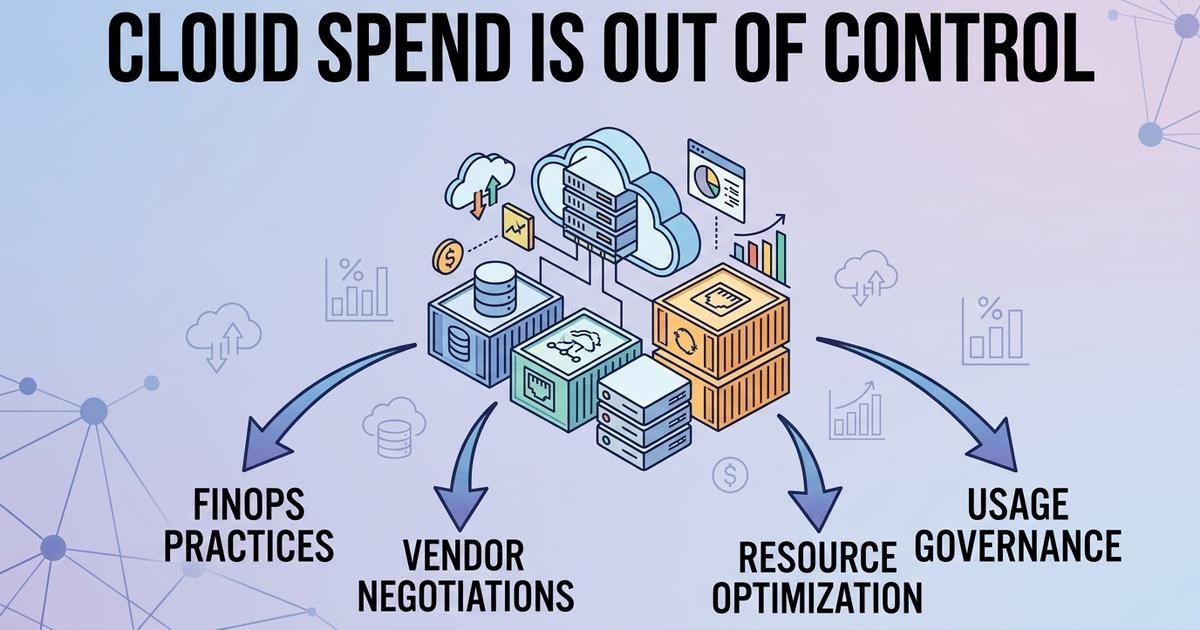

Cloud Spend Is Out of Control — Here's Whose Job It Is to Fix It
Nearly a third of what your organization spends on cloud infrastructure is being wasted right now, and after five years of steady improvement, that number just started climbing again. The question worth asking in your next leadership meeting isn't "how much are we spending on cloud" — it's "who owns making sure it isn't wasted."
Ready to fix cloud cost accountability in your organization?
Cloud computing was sold to leadership a decade ago on a simple promise: pay only for what you use, scale up and down as needed, no more over-provisioned data centers gathering dust. For a while, that promise mostly held. Then AI workloads arrived, and the promise quietly broke.
The result is showing up in the numbers now in a way that should concern any executive who signs off on a technology budget: cloud waste is rising for the first time in five years, and it's rising specifically because AI adoption is outrunning the cost-governance habits organizations spent years building.
Stats That Matter
- An estimated 29% of global cloud spend is wasted — the first increase in this figure in five years, reversing a long, hard-won downward trend.
- 72% of global companies exceeded their allocated cloud budgets in the last fiscal year.
- GPU spend at AI-forward organizations has grown from 4% to 18% of total cloud cost since 2023, and statically provisioned GPU fleets often run at only 30-40% utilization — meaning well over half of that expensive capacity sits idle.
Why This Isn't Just an Engineering Problem
The instinctive response from leadership when cloud costs spike is to send it back to engineering with a directive to "optimize." That response misdiagnoses the problem. Engineers aren't wasting cloud spend out of carelessness — they're provisioning infrastructure to hit delivery deadlines that leadership set, often without visibility into what that infrastructure costs relative to the value it creates.
The real gap, according to FinOps practitioners across nearly every recent industry survey, isn't overspending as a behavior problem — it's a visibility problem. Teams provision resources quickly because the business demands speed, but nobody has built the systems to show, in near real time, what that speed is costing and whether it's delivering proportional value. That's not something an engineering team can fix alone. It requires financial governance built into the organization the same way budget accountability exists for every other major cost center.
The AI Factor Is Making This Worse, Not Better
If your organization has recently ramped up AI initiatives, this problem is likely accelerating faster than your existing cost controls can track. AI infrastructure — GPU clusters, inference endpoints, model experimentation environments — is being spun up faster than finance teams can tag, forecast, or shut down. Unlike traditional cloud waste (an old server nobody remembered to decommission), AI waste often comes from expensive, specialized hardware left running well below its useful capacity, which makes each percentage point of waste dramatically more costly.
This creates a specific trap for leadership: the same AI investment being championed at the strategy level, discussed elsewhere in this series as a competitive necessity, is also the single biggest driver of runaway cloud cost if it isn't paired with financial governance from day one.
Why "Managing Cloud Spend" Rose to the Top of the CIO Agenda
Managing cloud spend has been reported as the number-one challenge facing cloud decision-makers, surpassing even security concerns. That ranking matters, because it tells you the problem isn't a handful of misconfigured accounts — it's structural. Executives who assume this is a minor operational detail handled somewhere below their pay grade are, by definition, not looking at the number that's costing their organization real money every month.
Whose Job Is It, Really?
This is the question the article's title poses, and the honest answer is: it's shared, but it needs an owner. The organizations that have closed the cloud waste gap share a common structural choice — they don't treat FinOps as a purely technical problem, and they don't treat it as a purely financial one either. They build accountability at the team level and visibility at the executive level.
In practice, that means:
Every engineering team owns a unit-economics view of its own costs. Cost per feature, cost per active user, cost per API call — metrics specific enough that a team can see the financial consequence of its own architecture decisions in real time, not three months later on an invoice.
Executives get roll-up visibility, not just a total bill. A single "cloud spend" number on a dashboard tells leadership nothing actionable. A breakdown by team, by initiative, and by whether spend correlates with revenue or user growth tells leadership exactly where to ask questions.
FinOps has a seat at the leadership table, not just in the server room. FinOps teams with direct executive or C-suite engagement are dramatically more likely to influence infrastructure decisions before money is spent, compared to teams that only have influence at the director level. Waiting until the invoice arrives to ask questions is, structurally, too late.
What This Means for Your Next Budget Cycle
If you're heading into a budget cycle without clear answers to "who is accountable for cloud cost efficiency, and what visibility do they have," you are very likely funding waste at scale without realizing it. A 20% waste rate on a $50 million annual cloud budget is $10 million a year — enough to fully justify a dedicated cost-governance function many times over, and enough that ignoring the question has a real, calculable cost to your organization.
Key Takeaways
- Cloud waste is now rising for the first time in five years, driven largely by AI infrastructure outpacing existing cost controls.
- This is fundamentally a visibility and accountability problem, not a carelessness problem — engineering teams provision to meet business deadlines without cost feedback loops.
- AI workloads make waste more expensive per unit than traditional cloud waste, since idle GPU capacity carries a much higher price tag than an idle server.
- The organizations that control this well give teams unit-economics ownership and give executives roll-up visibility — not just a single invoice total.
- FinOps functions with direct C-suite engagement have measurably more influence over infrastructure decisions before the spend happens, not after.
What to Do Next
If your organization doesn't have a clear owner for cloud cost accountability, or your leadership team only sees the total bill rather than where the waste lives, that's a fixable gap — but it requires building the right governance habits and training the right people to own them.
I work with a trainer who specializes in exactly this: helping leadership and engineering teams build the FinOps discipline needed to keep cloud investment tied to real business value. If this is on your radar for the next quarter, call or contact me and I'll help you get started.